Real Estate Referral Network: How to Build a System That Sends You Deals on Autopilot
By Will Rapuano | Velocity Builders|
Most real estate agents get referrals. They just can't predict them.
A past client mentions your name at a birthday party. A lender sends over a buyer they couldn't place with their own product but knows you'll handle well. An out-of-town agent has a client relocating to your market. These deals happen — and most agents treat them like weather: unpredictable, uncontrollable, and entirely dependent on luck.
Top producers think about referrals completely differently.
The agents closing 40, 60, 100+ transactions a year aren't just more likeable or better connected. They've built a structured real estate referral network — a system that consistently generates inbound business without them having to personally hustle for every lead.
Here's the difference between luck and a system, and how to build the latter.
What a Real Estate Referral Network Actually Is
A referral network isn't a list of people who like you. It's a managed system of relationships across multiple categories, each with a deliberate communication cadence and a clear value exchange.
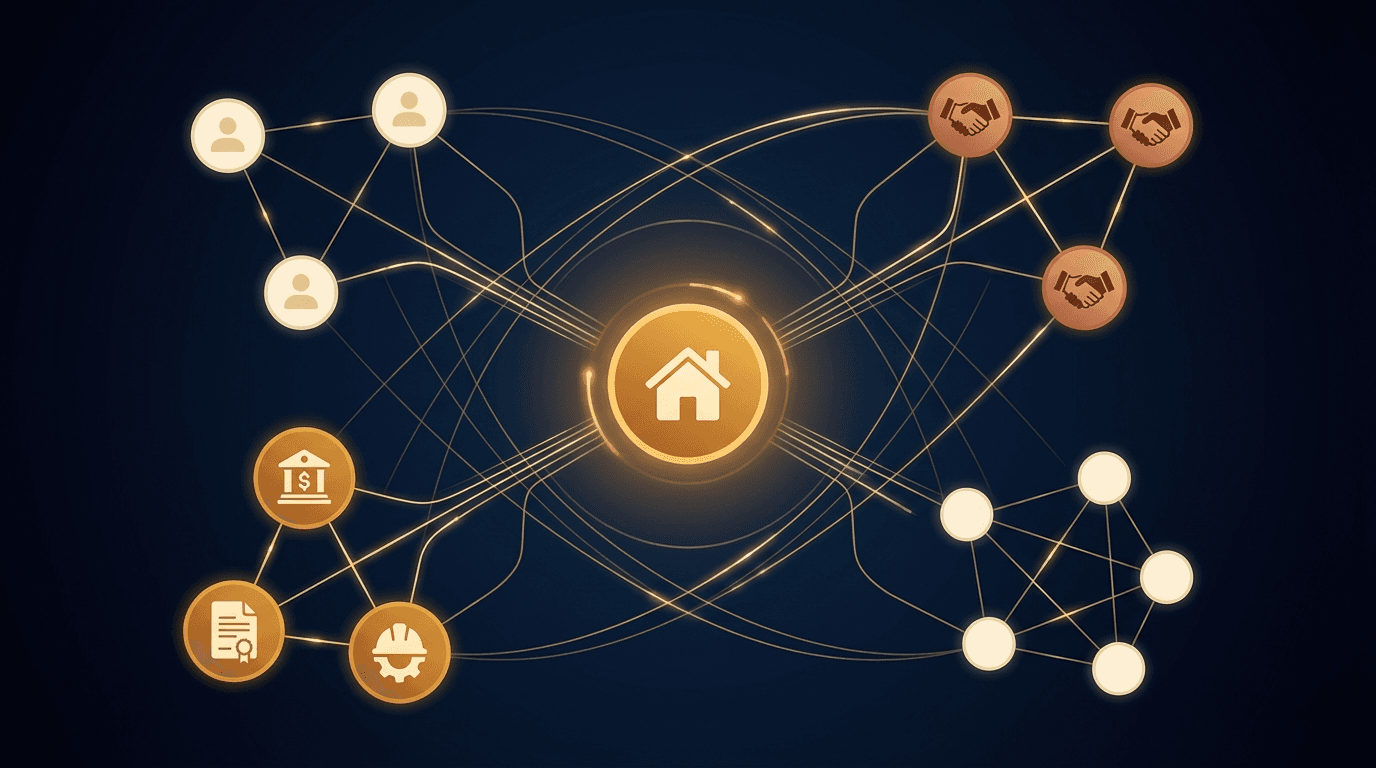
A real referral network has four components:
- Past clients — people you've already closed transactions for, who can speak to your work from direct experience
- Agent-to-agent referrals — other agents (especially out-of-market) who trust you with their clients when a relocation or cross-market move comes up
- Professional partners — lenders, title reps, contractors, attorneys, financial planners, estate attorneys, divorce attorneys
- Sphere of influence (SOI) — friends, family, neighbors, and community connections who haven't transacted with you yet but know and trust you
The key word across all four: managed. A referral network only works if you're maintaining it with intention. That's exactly where most agents fall apart.
Passive vs. Active: Why Most Agents Only Do Half the Work
Most agents operate a passive referral strategy. They do good work, stay vaguely top-of-mind, and hope people remember them when a conversation comes up.
Active referral systems are different. They have structure, cadence, and automation — and they run whether or not you're personally thinking about it.
| Passive Referral Strategy | Active Referral Network System |
|---|---|
| Sends a closing gift, then nothing | Sends gift + multi-year follow-up sequence |
| Hopes clients remember your name | Schedules check-in calls at 90 days, 1 year, 2 years post-close |
| Waits for lenders to send leads | Sets recurring meetings with key lending partners |
| Has no formal partner program | Runs a structured professional partner program with clear value exchange |
| "Remembers" to follow up sometimes | Uses CRM triggers, tasks, and automated touchpoints |
| Gets referrals when lucky | Gets referrals consistently |
The difference isn't effort — it's infrastructure.
How to Build Your Referral Network in Four Steps
Step 1: Build Your Past Client Database and Segment It
Start with everyone you've closed a transaction for. Tag each contact with a relationship strength indicator — A (strong relationship, would definitely refer), B (positive experience, might refer with prompting), C (you know them but the relationship has gone cold).
From there, build a long-term nurture sequence in your CRM:
- 30 days post-close: Check in on the home. Any questions about the process?
- 90 days: How's the neighborhood settling in? Any immediate needs?
- 6 months: Market update for their zip code — here's what their home is worth right now.
- 1 year: Anniversary touchpoint. A card, a call, or a genuine value email.
- Annual thereafter: Market report plus personal check-in.
This isn't manual work. It's an automated sequence that runs in the background of your CRM. You configure it once; it runs until the contact transacts again.
Step 2: Build an Agent-to-Agent Referral Pipeline
This is the most underused referral channel in the business. Every week, agents across the country have clients relocating to your market — and they need someone they trust to hand them off to.
How to build it:
- Join Facebook groups and agent communities serving feeder markets (if you work Northern Virginia: New York, Chicago, Boston, and Texas all funnel buyers your way)
- Connect with agents in those markets directly — a personal introduction message, not a form letter
- When you receive a referral, close it well and report back with a full update — timeline, how the clients felt, outcome
- Keep a "referral partner" segment in your CRM with quarterly touch reminders
The agents who collect the most cross-market referrals are the ones who follow up after the transaction with a genuine thank-you and a clear deal summary. Word travels in those networks.
Step 3: Build a Professional Partner Program
Lenders, title reps, contractors, estate attorneys, divorce attorneys, financial planners — these professionals talk to your potential clients at key life transition moments. When they have someone who needs an agent, you want to be the person they call.
How to build it:
- Identify your top 10 professional partners — the ones already sending you leads or who should be
- Schedule a quarterly coffee or call with each
- Build a clear value exchange: you'll actively promote them to your clients; they promote you to theirs
- Add them to your CRM in a dedicated "partner" segment with quarterly follow-up reminders
- Ask directly: "When you have a client who needs an agent, can I be your go-to?"
Most agents never ask that question explicitly. The ones who do hear yes far more often than you'd expect.
Step 4: Automate Your SOI Touchpoints
Your sphere of influence doesn't need a monthly sales pitch. They need to see your name consistently enough that you're the obvious answer when real estate comes up in conversation.
A quarterly SOI touch schedule:
- Q1: Local market update email — real data on your market, not generic content
- Q2: Personal check-in or community event invitation
- Q3: Mid-year market snapshot — inventory, values, what to watch
- Q4: Year-in-review plus holiday card
Tag all SOI contacts in your CRM and set annual recurring task reminders for each. Done.
The CRM Automation Layer
Here's what separates agents who say they have a system from agents who actually generate consistent referrals: CRM automation removes the memory load entirely.
You should not be manually tracking when to call a past client, when to check in with a lender, or when someone's transaction anniversary is. Your CRM should handle that.
At Velocity Builders, we build these automations into agent marketing systems — so the referral follow-up runs whether you're on vacation or on a listing appointment. A properly configured referral automation stack includes:
- Automated email sequences triggered by transaction close date
- Task reminders for personal calls at key intervals (30 days, 90 days, 1 year post-close)
- Lead scoring to surface which contacts in your database are most likely to transact in the next 6 months
- Re-engagement workflows for cold SOI contacts who haven't opened an email in 90+ days
- Partner touchpoint reminders — calendar integrations that prompt quarterly check-ins with your top referral partners
This is not about replacing relationships. It's about making sure you never accidentally go dark on someone who matters.
The Most Common Referral Mistakes
No system at all. You're relying on your own memory and personal motivation to follow up. Memory fades. Motivation fluctuates. Systems don't.
Inconsistent cadence. You send a holiday card, then go quiet for 14 months. The contact goes cold. When they're ready to sell, someone else's name comes up first.
Never asking explicitly. Most agents hint at referrals without directly asking. "If you know anyone..." is weak. "If you have a friend or colleague thinking about buying or selling this year, I'd be honored if you'd introduce us — is there anyone who comes to mind?" is direct and actionable. The explicit ask converts.
Only focusing on past clients. The fastest-growing agents diversify. Agent-to-agent referrals and professional partner leads often convert faster and at higher price points than pure SOI contacts — because they arrive with a trusted endorsement already attached.
Velocity Builders helps real estate agents, lenders, and brokerages build websites and marketing systems that generate and convert leads automatically.
Will Rapuano
Founder, Velocity Builders LLC. Business Development Officer at Pruitt Title. Helping real estate agents and loan officers scale with better marketing systems.
Book a 20-Minute Growth Blueprint
See where your lead handoff and follow-up are leaking deals, then fix the right things first.
Book a 20-Minute Growth Blueprint