Luxury Real Estate Marketing Materials: What Actually Works When You're Selling Premium Homes
By Will Rapuano | Velocity Builders|
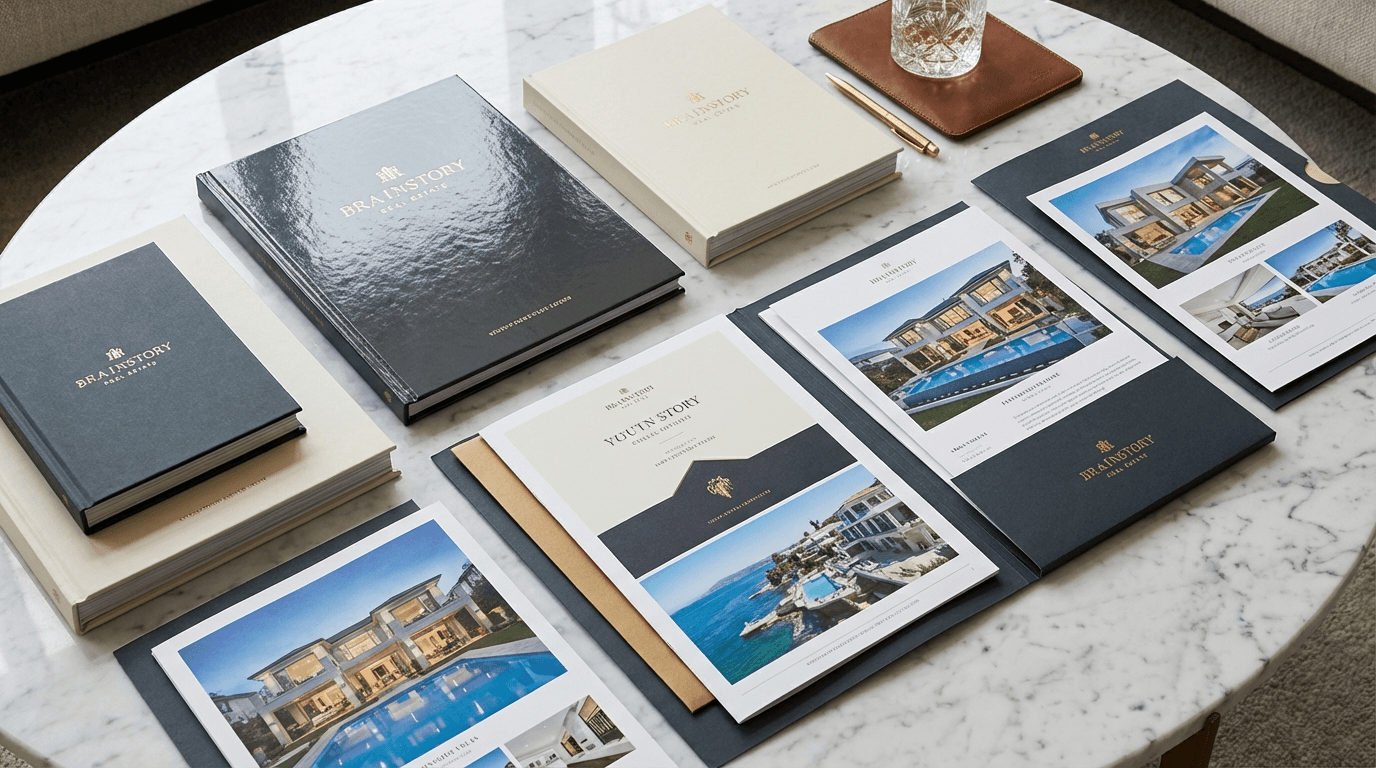
When a seller lists a $3M home, they're not just choosing an agent. They're choosing a marketing partner. Your materials are the audition. And in the luxury market, "polished" is table stakes — the question is whether your materials signal that you understand what actually sells premium properties.
Most luxury real estate marketing materials fail because they prioritize aesthetics over strategy. Beautiful photos on cheap paper. Thick brochures with no compelling narrative. Digital presentations that look like every other agent's Canva deck. The result: sellers see through it, and buyers scroll past it.
Here's what actually works.
Why Luxury Marketing Materials Are Different
Luxury buyers don't behave like typical buyers. They're not scrolling Zillow at midnight hoping something pops. They're receiving curated presentations, getting personal calls from trusted agents, and often making decisions based on private showings before a property ever goes public.
That means your marketing materials serve two audiences at once:
First, the seller. Your pre-listing presentation and property materials tell the seller exactly how seriously you take their home — and whether you understand the buyer profile.
Second, the buyer's agent. In luxury transactions, buyer's agents are often the first filter. Your property materials land in their inboxes before any showing is scheduled. They need to communicate the property's story with enough detail that an agent can pre-qualify their client's interest without a visit.
Build materials for both.
The Non-Negotiable Foundation: Professional Photography and Video
No marketing material for a luxury property survives mediocre photography. Full stop.
For homes above $1M, budget for:
Architectural photography — a dedicated real estate photographer who understands light, composition, and how to make square footage feel like lifestyle. Not your cousin with a nice camera.
Twilight exterior shots — the single most powerful visual tool in luxury marketing. A property lit from within at dusk, surrounded by landscaping, signals prestige in a way that midday sun photos never will.
Drone footage — for properties with acreage, water frontage, mountain views, or distinctive rooflines. Context matters. Buyers of $2M+ homes want to understand the land, the setting, the privacy envelope.
Virtual tour — not as a replacement for in-person showings, but as a qualification filter. A high-quality interactive tour eliminates buyers who wouldn't have made it past the driveway anyway, and keeps your seller's home from turning into a tourist attraction.
Your photography is the raw material. Everything else is the package.
Property Brochures: Weight, Paper, and Restraint
The physical brochure still matters in luxury. Not because print is making a comeback — it's because the tactile experience communicates investment in a way a PDF never will.
What separates premium from pretentious:
Paper stock — use 100lb coated or uncoated cover stock minimum. The brochure should have weight in the hand. If it flops when you hold a corner, it communicates budget, not luxury.
Format — oversized works. A 9x12 or 8.5x11 horizontal format gives architectural photography room to breathe. Tri-folds feel like a Marriott rack card. Use them for price points under $750K, not for your flagship listings.
Restraint in copy — one of the most common mistakes in luxury brochures is writing too much. The property photos should do the heavy lifting. Your copy needs to capture the lifestyle, the setting, and the unique value proposition in 200 words or fewer per section. If your seller needs to read three paragraphs to understand why the primary suite is notable, the photography hasn't done its job.
Single-property focus — never include multiple listings in a luxury brochure. Each property deserves its own piece. Buyers notice when you're trying to amortize your printing cost across listings.
Digital Presentation: Where Most Agents Under-Deliver
The listing presentation deck you bring to a $2.5M seller appointment is the most important marketing material you own. Here's the sequence that converts:
Open with their property, not your bio. Most agents open with the company logo, their team photo, and their sales volume. The seller doesn't care. Open with a rendered vision of how you'll position and market their home specifically. Show them the buyer profile you're targeting. Name the feeder markets.
Competitive positioning, not comps. Comps tell sellers what their home is worth. Positioning tells them why yours is the firm that can achieve it. Walk through the three most comparable active listings and explain why a buyer choosing between them should choose your listing — and exactly what you'll do to create that advantage.
Specific channel plan, not a laundry list. "We use social media, email marketing, and our website" is not a marketing plan. It's the content that says you don't have one. Replace the channel laundry list with specific actions: the influencer partnerships you'll use for the property launch, the private network of buyer agents you'll contact personally in the first 48 hours, the international real estate network reach for foreign buyer exposure, the specific publications where you'll place editorial.
Proof in the form of stories, not statistics. "I sold 47 luxury homes last year" lands differently than "Here's how I sold 412 Maple Ridge — a property that sat with two other agents for 180 days — in 23 days at 98% of list price." Lead with a case study from a comparable transaction. Make it specific enough that the seller can picture themselves in the outcome.
Digital Marketing: The Channels That Reach Luxury Buyers
Luxury buyers in 2026 use the same internet as everyone else. They Google. They Instagram. They share listings in Signal threads with their financial advisors. Platform reach still matters — but targeting does more work.
Facebook and Instagram — your target is not "homeowners in [zip code]." Run income, net worth, and interest-based targeting toward individuals with household incomes above $300K and demonstrated luxury lifestyle interests. Facebook's detailed targeting options still allow this. Use it.
Google Display and Search — luxury buyers searching for high-end neighborhoods, private schools, golf communities, or equestrian properties are telling you exactly who they are. Capture that intent with specifically targeted campaigns.
Email to buyer agent networks — don't underestimate this. A personal email from you to 50 buyer's agents who specialize in your price point, with professional photography and the property's narrative story, will generate more serious inquiries than any social post. Your network is a marketing channel. Treat it like one.
Private network announcements — the pre-market or pocket listing strategy exists at this price point for a reason. If your marketing is good enough, you can generate interest before the property goes public. For sellers who value privacy, this is a feature, not a limitation.
What to Cut
Luxury real estate marketing materials fail most often not from what's missing, but from what shouldn't be there.
Cut the team photo on the front page of the brochure. The home is the hero, not your headshot.
Cut generic market statistics that don't connect to the specific property. Citing a national median home price increase in a brochure for a $4M waterfront estate isn't relevant — it's filler.
Cut the QR code to your general website. Every piece of luxury collateral should drive to a dedicated single-property page, not your homepage.
Cut the awards grid. One line noting your brokerage's market position is sufficient. A collage of achievement plaques signals insecurity, not credibility.
The goal of every piece of luxury marketing collateral is to make the property feel inevitable — the obvious choice for the right buyer. When your materials are disciplined enough to stay focused on that, they work.
Velocity Builders helps real estate agents, lenders, and brokerages build websites and marketing systems that generate and convert leads automatically.
Will Rapuano
Founder, Velocity Builders LLC. Business Development Officer at Pruitt Title. Helping real estate agents and loan officers scale with better marketing systems.
Book a 20-Minute Growth Blueprint
See where your lead handoff and follow-up are leaking deals, then fix the right things first.
Book a 20-Minute Growth Blueprint