Google Ads for Realtors: A No-Nonsense Guide to Paid Search in 2026
By Will Rapuano | Velocity Builders|
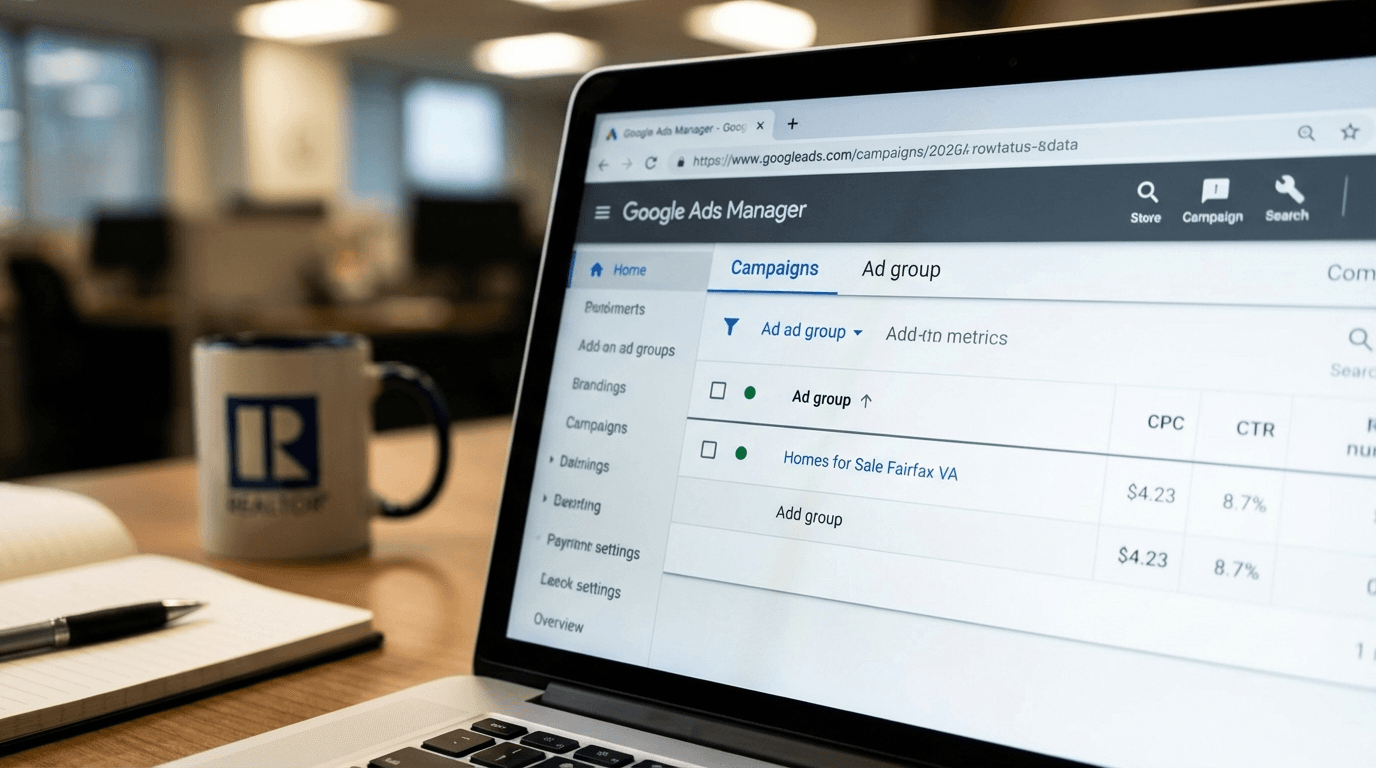
Most real estate agents who've tried Google Ads have one of two stories: they tried it, spent a few hundred dollars, got zero leads, and quit. Or they're still running campaigns that technically produce clicks but haven't closed a single deal.
Very few have the third story — the one where Google Ads became a consistent, predictable source of buyer and seller leads that actually converted to closed transactions.
The difference isn't luck. It's knowing what you're doing.
Google Ads for realtors is one of the highest-intent lead sources available. The person typing "buy a house in [your city]" into Google at 10 PM is not casually browsing. They're actively in the market. Your job is to be there when they search, send them somewhere compelling, and give them a reason to call you.
This guide breaks down exactly how to do that without setting your marketing budget on fire.
Why Google Ads Works Differently for Real Estate
Before getting into tactics, you need to understand one thing that makes real estate PPC different from most other industries: the conversion cycle is long.
A lead from a Google ad who's searching "homes for sale in [suburb]" might not close for 90 to 180 days. Maybe longer. This means your cost-per-acquisition looks terrible in month one, acceptable in month three, and justified in month six — if you're tracking correctly.
Agents who abandon Google Ads after 45 days because they "didn't see results" are quitting right before the machine would have paid off. The ones who stay disciplined, optimize consistently, and nurture leads through the pipeline are the ones who make it work.
The other key difference: intent is everything in real estate search. The keyword "homes for sale in [city]" signals readiness to act. The keyword "real estate" signals nothing. Your campaigns live or die on your ability to target the right intent, not just the highest volume.
The Four Types of Google Ads Campaigns That Work for Realtors
Not all campaign types are created equal for real estate. Here's where the money should actually go.
1. Search Campaigns — Your Bread and Butter
Standard search campaigns match your ads to keywords typed into Google. For realtors, the winning keyword categories are:
Transactional buyer keywords:
ℹ️ Transactional buyer keywords
- —"[city] homes for sale"
- —"houses for sale in [neighborhood]"
- —"buy a home in [city]"
- —"new construction homes [city]"
- —"[bedroom count] bedroom homes [city]"
Transactional seller keywords:
ℹ️ Transactional seller keywords
- —"sell my home in [city]"
- —"home valuation [city]"
- —"what is my home worth [city]"
- —"real estate agent [city]"
- —"[city] listing agent"
Relocation keywords:
ℹ️ Relocation keywords
- —"moving to [city]"
- —"best neighborhoods in [city]"
- —"living in [city]"
These are your highest-value keywords. They represent people who are actively in the process, not just researching generally.
2. Performance Max Campaigns — Proceed With Caution
Performance Max (PMax) campaigns let Google automatically distribute ads across Search, Display, YouTube, Gmail, and Maps. They've gotten more capable, but for most solo agents and small teams, they're a black box.
PMax works well if you have strong creative assets (video, high-quality images) and a clear conversion goal (lead form submissions, calls). It works poorly if you're trying to control who sees your ads or understand where your budget is going.
Recommendation: start with manual search campaigns, get your cost-per-lead dialed in, then layer in PMax once you have baseline data.
3. Local Services Ads — The Underrated Option
Local Services Ads (LSAs) are a separate product from Google Ads proper. You pay per lead, not per click, and your ads show up at the very top of search results with a "Google Screened" badge.
For realtors, LSAs are often more cost-effective than traditional search campaigns because you only pay when someone actually contacts you through the ad — not when they click through and bounce. The verification process (background check, license verification) takes a few weeks, but the trust signal it provides is worth it.
If you're not running LSAs alongside your regular Google Ads, you're leaving qualified leads on the table.
4. Remarketing — Recapturing the People Who Already Found You
Only about 2-5% of people who visit your website for the first time will contact you. Remarketing lets you continue showing ads to the other 95% as they browse the web.
For real estate, remarketing is particularly powerful. Someone who visited your "McLean homes for sale" page and left is still a warm prospect. A remarketing campaign that shows them relevant ads over the next 30-60 days — with listings, market updates, or an offer of a free home valuation — keeps you top of mind through the slow part of their decision process.
Remarketing clicks are cheaper than search clicks. And the people seeing them already know who you are.
How to Structure Your Real Estate Google Ads Campaigns
Campaign structure is where most agents go wrong. They dump every keyword into one campaign, set a modest daily budget, and wonder why the results are so inconsistent.
Here's a structure that works:
Campaign 1: Buyer — High Intent
Ad groups: city homes for sale, neighborhood homes for sale, new construction
Budget allocation: 40-50% of total
Campaign 2: Seller — Home Valuation
Ad groups: sell my home, home value, listing agent
Budget allocation: 30-35% of total
Campaign 3: Relocation / Research
Ad groups: moving to [city], best neighborhoods, living in [city]
Budget allocation: 15-20% of total
Campaign 4: Remarketing
Audience: website visitors, engaged users, YouTube viewers (if applicable)
Budget allocation: 10-15% of total
Why separate campaigns for buyers and sellers? Because the landing page, the ad copy, and the conversion goal are completely different. A buyer keyword should send traffic to a property search or buyer guide page. A seller keyword should send traffic to a home valuation tool or listing consultation offer.
Mixing them in one campaign means you're either sending buyers to a seller page or sellers to a buyer page. Both convert poorly.
The Landing Page Problem (Most Agents Get This Wrong)
Sending Google Ads traffic to your homepage is a conversion killer. Your homepage is designed to communicate your overall brand. A landing page is designed to do one thing: convert a specific visitor with a specific intent into a lead.
For each campaign, you need a dedicated landing page:
Buyer landing page:
ℹ️ Buyer landing page
- —A headline that matches the ad ("Homes for Sale in [City] — Updated Daily")
- —IDX property search integration
- —A value offer: free buyer guide, market report, or consultation
- —A simple lead capture form (name, email, phone, and maybe a question like "when are you hoping to move?")
- —Social proof: reviews, transaction count, local credentials
Seller landing page:
ℹ️ Seller landing page
- —Instant home valuation tool (integrated with a service like HomeBot, Homelight, or your own form)
- —A brief description of your listing process and what sellers get
- —Recent sales in the neighborhood (shows you're active locally)
- —Strong call to action for a listing consultation
The goal for every landing page: make the next step obvious and the friction minimal. If someone has to hunt for a contact form, you've lost them.
Keyword Matching: What Every Realtor Running Google Ads Needs to Know
Match types determine when your ads show up. Getting this wrong means paying for clicks that have nothing to do with your business.
Broad match: Your ad can show for any search Google thinks is related to your keyword. Almost always too broad for real estate. "Homes for sale" on broad match might trigger for searches like "homes for sale in other states entirely" or vaguely related searches you'd never want to pay for.
Phrase match: Your ad shows when a search contains your keyword phrase in order. "[City] homes for sale" on phrase match will show for "affordable [city] homes for sale" and "[city] homes for sale under 500k" — which are both relevant. This is the safest default for most real estate keywords.
Exact match: Your ad only shows for that precise search (and close variants). Use exact match for your highest-value, most specific keywords where you know the exact search someone makes when they're ready to contact an agent.
Negative keywords are just as important as your positive keyword list. Add these to every campaign immediately:
- rental, rent, apartment, apartments
- jobs, career, agent training, how to become
- free, cheap, discount
- commercial, commercial real estate
- out-of-state markets you don't serve
Without a solid negative keyword list, you'll pay for clicks from renters, job seekers, and people searching markets you can't help with.
What to Budget for Google Ads as a Realtor
Real estate is one of the most competitive Google Ads categories. In major metro areas, cost-per-click on buyer keywords can run $5-$25 or higher. In smaller markets, you might see $2-$8 per click.
A realistic minimum test budget is $1,000-$1,500/month for the first 90 days. At that spend level, you'll generate enough data to understand your actual cost-per-lead and start optimizing. Below that, the data is too thin to draw conclusions.
More important than the dollar amount is the cost-per-lead target. For a transaction where you'll earn a $15,000-$20,000 commission, a cost-per-lead of $50-$150 is entirely sustainable — if your lead-to-close rate is healthy. Agents who panic at $100 cost-per-lead without knowing their close rate are optimizing the wrong metric.
The math that matters:
ℹ️ The math that matters
- —100 leads × $100 CPL = $10,000 ad spend
- —Close rate of 3% = 3 closed deals
- —Average commission = $15,000
- —Return on ad spend = 4.5x
That's a profitable campaign. Work backwards from those numbers for your market.
Tracking: If You Can't Measure It, You Can't Improve It
This is where most agent Google Ads campaigns completely fall apart. If you can't tie closed deals back to specific campaigns, keywords, and ad groups, you're flying blind.
At minimum, set up:
Google Analytics 4 + Google Ads linked: Every landing page visit, every form submission, every call tracked back to the campaign and keyword that generated it.
Call tracking: Use a service like CallRail or a Google forwarding number to track phone calls from ads. Real estate leads often call rather than fill out forms — if you're not tracking calls, you're missing half your attribution.
CRM tagging: When a lead comes in from Google Ads, tag it in your CRM. Track the lead through the pipeline. When it closes, you'll know exactly what it cost you to acquire that client.
Conversion goals: Set up conversion events in Google Ads for form submissions, calls lasting more than 60 seconds, and IDX property saves. Without conversion tracking, Google's algorithm can't optimize toward the outcomes that matter.
Common Google Ads Mistakes Realtors Make
Running campaigns without conversion tracking. If Google doesn't know what a conversion looks like, it can't optimize for conversions. Your campaign will optimize for clicks — which is not the goal.
Using only broad match keywords. You'll burn budget on irrelevant traffic within the first week.
Sending all traffic to the homepage. A homepage is not a landing page. Your conversion rate will be a fraction of what a dedicated landing page achieves.
Setting the budget and walking away. Google Ads requires active management. At minimum, review your search term report weekly, add negative keywords, pause underperforming ad groups, and test new ad copy monthly.
Not testing ad copy. Run at least two to three variations of every ad. Different headlines, different offers, different calls to action. Let the data tell you what resonates with your audience.
Stopping too soon. Three to four months of consistent data is the minimum before you can draw meaningful conclusions about a campaign's performance. Agents who quit after six weeks haven't given the system enough time.
Google Ads vs. Zillow and Other Lead Portals
This question comes up constantly: is Google Ads better than paying for Zillow Premier Agent or similar lead portal products?
The honest answer is: they serve different purposes and have different risk profiles.
Zillow/Realtor.com leads:
ℹ️ Zillow/Realtor.com leads
- —You're renting access to their audience — when you stop paying, the leads stop
- —Lead quality varies wildly; high volume, lower intent on average
- —You're competing with other agents on the same platform
- —No data ownership — you can't build on it
Google Ads leads:
ℹ️ Google Ads leads
- —You're building your own presence in search results
- —Higher intent on average — people searched for "you" (or someone like you)
- —The data and audience lists you build are yours
- —Takes longer to optimize, but the infrastructure compounds over time
The smartest strategy is usually both, not either/or. Use Zillow or a portal for volume while your Google Ads campaigns ramp up and optimize. Gradually shift budget toward owned channels as your cost-per-acquisition improves.
Frequently Asked Questions
Velocity Builders helps real estate agents, lenders, and brokerages build websites and marketing systems that generate and convert leads automatically.
Will Rapuano
Founder, Velocity Builders LLC. Business Development Officer at Pruitt Title. Helping real estate agents and loan officers scale with better marketing systems.
Book a 20-Minute Growth Blueprint
See where your lead handoff and follow-up are leaking deals, then fix the right things first.
Book a 20-Minute Growth Blueprint